
“Do not judge, or you too will be judged. For in the same way you judge others, you will be judged, and with the measure you use, it will be measured to you.” — Matthew 7:1-2 (NIV)
Recently, I had a conversation with someone who did not understand homelessness. They described people experiencing homelessness as lazy and suggested they simply want society to take care of them. Their response was, “Why don’t they just get a job?”
As I listened, I found myself wondering where these misconceptions come from.
Has this person ever sat down and had a real conversation with someone experiencing homelessness? Have they ever asked someone how they got there? Or are they making judgments based on what they see from a distance—perhaps witnessing someone struggling with addiction and assuming that everyone experiencing homelessness shares the same story?
The reality is that homelessness is far more complex than many people realize.
The Danger of Judging Without Knowing the Story
The Bible warns us about judging others without understanding their circumstances. In Matthew 7:1-2, Jesus reminds us that the measure we use to judge others will be the same measure used to judge us.
How can we fairly judge someone when we do not know their story?
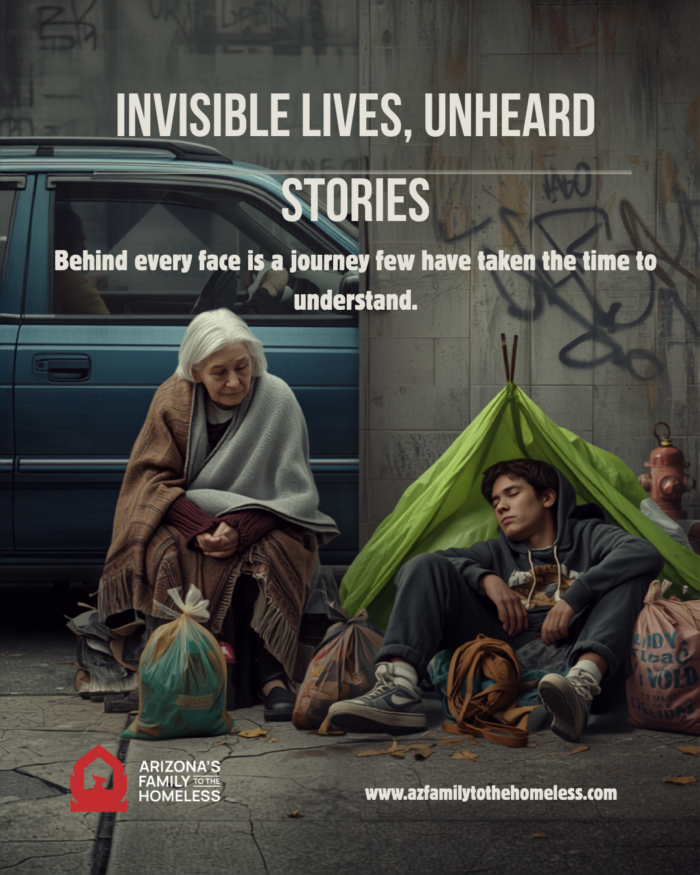
How can we look at a person sleeping in a car, living in a tent, or sitting on a street corner and assume we know every decision, hardship, loss, and struggle that brought them there?
Many of us have experienced difficult seasons in life. We’ve faced illness, job loss, divorce, unexpected expenses, family crises, or personal tragedies. The difference between stability and homelessness is often much smaller than people realize.
Most of us are fortunate enough to have a support system—a family member willing to let us stay in a spare room, a friend who can help financially, or savings that help us weather a difficult season. But what happens when those safety nets don’t exist?
Have We Lost Our Ability to Show Kindness?
I often wonder where we are as a society if we have lost our ability to simply show kindness and compassion toward someone who is suffering.
When did it become easier to make assumptions than to ask questions?
When did criticism become more common than compassion?
Jesus taught us to “Love your neighbor as yourself” (Mark 12:31).
Loving our neighbor does not require us to know every detail of their life. It requires us to recognize their humanity.
Instead of making judgments, shouldn’t we take the time to learn about people’s stories?
Shouldn’t we listen before we label?
Shouldn’t we seek understanding before forming opinions?
I Don’t Think Anyone Dreams of Being Homeless
I don’t think anyone wants to be homeless.
I don’t think children grow up dreaming about sleeping in a car, living in a shelter, or wondering where their next meal will come from.
No child says, “When I grow up, I hope I become homeless.”
So, if people do not aspire to homelessness, how does it happen?
Perhaps the best way to answer that question is simple:
Let’s ask them.
One Woman’s Story
Recently, while serving at an outreach event, I had the opportunity to speak with a woman experiencing homelessness. Rather than making assumptions, I asked a simple question:
“How did you become homeless?”
Her answer was heartbreaking—and eye-opening.
She explained that she had become homeless only three months earlier.
Today, she lives in her car.
She also has a part-time job.
That alone challenges the stereotype that people experiencing homelessness simply refuse to work.
As she continued sharing her story, she explained that she had undergone two major surgeries. The surgeries left her unable to maintain full-time employment for an extended period. At the same time, she was fleeing a domestic violence situation.
The combination of hospitalization, recovery, lost income, and personal crisis created a perfect storm.
Without income for several months, she fell behind on her rent and was eventually evicted.
After recovering from surgery, she secured a part-time job and has been working to rebuild her life. Yet despite her efforts, the income she earns is still not enough to secure stable housing.
She is actively searching for solutions.
She wants a home.
She wants stability.
She wants to rebuild her life.
One of the biggest barriers she faces is finding affordable housing that will allow her to keep her dog—a companion she deeply loves and who has provided comfort during one of the most difficult seasons of her life.
Her story is not one of laziness.
It is a story about medical hardship.
It is a story about domestic violence.
It is a story of lost income.
It is a story about survival.
Another Story: When Retirement Isn’t Enough
At another outreach, I met an elderly gentleman whose path to homelessness looked very different yet ended up in the same place.
For years, he lived independently on a fixed income consisting of Social Security and a modest retirement benefit. He wasn’t living extravagantly. He paid his bills, bought groceries, and did his best to make his income stretch each month.
Then his rent began to increase.
Year after year, the rent rose while his income stayed largely the same.
Eventually, he reached a point where the numbers simply no longer worked.
After paying for food, transportation, medication, and other necessities, there was not enough money left to cover the rent.
He fell behind.
Soon afterward, he was evicted.
Today, he is living in his car.
His story highlights a growing reality in many communities. Seniors living on fixed incomes are among the most vulnerable populations when it comes to housing instability.
Many have no family members to lean on.
Many are too old to easily return to the workforce.
Many face chronic health conditions or disabilities.
As housing costs continue to rise, more seniors are finding themselves forced to choose between paying rent, buying food, or paying for medication.
For some, the choice is made for them when housing costs exceed what their income can support.
Sadly, many aging adults do not know where to turn for help until their housing situation has already become a crisis.
What Happens When the Car Is Gone?
Living in a car may provide temporary shelter, but it comes with risks of its own.
What happens when that vehicle breaks down?
What happens when it gets towed because it was parked in the wrong location?
What happens when the one thing standing between a person and sleeping on the sidewalk disappears?
For many people experiencing homelessness, their vehicle is far more than transportation. It is their shelter, storage unit, closet, and safe space.
Inside may be everything they own:
- Identification cards
- Birth certificates
- Social Security cards
- Medical records
- Employment paperwork
- Family photographs
- Personal belongings
Without these documents, getting help becomes even more difficult. Replacing them often requires money, transportation, and a mailing address—resources many people experiencing homelessness simply do not have.
One obstacle quickly becomes many obstacles.
The Many Faces of Homelessness
What about the young adults who age out of foster care and have nowhere to go?
What about the individual experiencing a mental health crisis?
What about the parent fleeing domestic violence?
What about the family devastated by a medical emergency?
What about the worker whose hours were reduced just as rent increased?
What about the senior whose fixed income can no longer cover the cost of housing?
Every person experiencing homelessness has a story.
Some stories involve addiction.
Many do not.
Some stories involve poor decisions.
Many involve circumstances beyond a person’s control.
Most stories are far more complex than the stereotypes society often attaches to homelessness.
The truth is that homelessness can result from many factors:
- Medical emergencies
- Domestic violence
- Rising housing costs
- Job loss or reduced work hours
- Mental health challenges
- Disability
- Family breakdown
- Fixed-income seniors facing increased rents
- Aging out of foster care
- Lack of affordable housing
- Unexpected financial crises
Homelessness does not have a single face.
There Is No Single Solution
One of the greatest misconceptions about homelessness is the belief that there is a simple solution.
There isn’t.
Homelessness is a complex issue that requires multiple solutions.
Affordable housing is part of the solution.
Employment opportunities are part of the solution.
Mental health services are part of the solution.
Domestic violence resources are part of the solution.
Senior housing programs are part of the solution.
Prevention programs are part of the solution.
No single program or organization can solve homelessness alone because people become homeless for many different reasons.
If One Size Doesn’t Fit All, What Are the Solutions?
After hearing story after story from people experiencing homelessness, one thing becomes clear:
There is no single reason people become homeless, which means there can be no single solution.
The woman fleeing domestic violence has different needs than the senior living on Social Security. The young adult aging out of foster care faces different challenges than someone recovering from a medical crisis. A veteran struggling with trauma may need different support than a family facing eviction after a job loss.
Yet many of our assistance programs are designed to serve only specific populations.
A domestic violence shelter may only be able to assist individuals fleeing abuse.
A senior housing program may only serve older adults.
A transitional housing program may only serve veterans.
A food pantry may be limited by funding restrictions, zip code requirements, income qualifications, or geographic service areas.
While these programs provide critically important services, they often leave gaps that people struggling with homelessness and poverty can fall through.
Imagine being in crisis, calling program after program, only to hear:
“We don’t serve your population.”
“You don’t meet our eligibility requirements.”
“You live outside our service area.”
“We don’t have any openings.”
“We’re currently on a waiting list.”
For someone already experiencing trauma, uncertainty, or hopelessness, every rejection becomes another barrier.
People don’t stop seeking help because they don’t want assistance.
Many stop because the process becomes overwhelming and discouraging.
The Hidden Cost of Restricted Funding
Many people don’t realize that nonprofits often face the same frustrations as the people they are trying to help.
Organizations frequently depend on grants and funding sources that come with restrictions on how the money can be used and who can be served.
A nonprofit may meet a family in desperate need and genuinely want to help, but the funding they received may only be designated for seniors, domestic violence survivors, veterans, or another specific population.
The need exists.
The willingness to help exists.
But the funding restrictions create barriers.
As a result, nonprofits often find themselves turning people away—not because they don’t care, but because they are limited by the rules attached to the funding.
At the same time, individuals seeking help become frustrated because they cannot understand why there are so many organizations in the community, yet no one seems able to meet their immediate needs.
The reality is that both sides are struggling within a system that is often fragmented and difficult to navigate.
When Help Becomes Too Complicated
For a person experiencing homelessness, finding assistance can sometimes feel like navigating a maze.
One agency provides referrals.
Another provides food.
Another offers case management.
Another handles housing.
Others assist with mental health services.
Another may help with employment.
Another may help only if there are children involved.
Another serves only a certain zip code.
Meanwhile, the individual in crisis is expected to coordinate all these services while trying to survive day-to-day.
Imagine trying to accomplish all of this while sleeping in a car.
Imagine doing it without reliable transportation.
Imagine doing it without internet access.
Imagine doing it while struggling with a medical condition, mental health challenge, or the emotional stress of losing your home.
Is it any wonder that some people eventually give up?
What If We Designed Systems Around People Instead of Programs?
Perhaps the better question is not:
“Why aren’t people finding help?”
Perhaps the question should be:
“Why is help so difficult to find?”
What if our communities worked toward building systems that focus on the whole person rather than placing people into narrow categories?
What if someone could enter one doorway and receive coordinated support based on their unique circumstances?
What if organizations worked more closely together to eliminate service gaps?
What if funding sources allowed greater flexibility to respond to real-life emergencies rather than specific classifications?
What if helping people became less about determining who qualifies and more about understanding what they need?
A Community Problem Requires a Community Solution
If we are going to reduce homelessness, food insecurity, and housing instability, we must recognize that these issues affect all types of people.
Homelessness does not discriminate.
It affects young adults aging out of foster care.
It affects families.
It affects seniors.
It affects veterans.
It affects people fleeing violence.
It affects people recovering from illness.
It affects people who work.
It affects people who have nowhere else to turn.
The solution will require collaboration between nonprofits, churches, businesses, healthcare providers, government agencies, landlords, community leaders, and caring citizens.
We need more affordable housing.
We need more prevention programs.
We need better coordination between services.
We need greater flexibility in funding.
We need increased community awareness.
And perhaps most importantly, we need more compassion.
Can We Create a Solution Where Everyone Receives the Help They Deserve?
Maybe the answer is not a single program.
Maybe the answer is a community that refuses to let people fall through cracks.
A community that listens.
A community that collaborates.
A community that sees people, not categories.
A community that values human dignity above paperwork and eligibility requirements.
Can we create a solution where everyone receives the help they deserve?
Perhaps not through one organization.
Perhaps not through one program.
But together, as a community committed to helping our neighbors, we can build something better than what exists today.
Because no one should choose between food and rent.
No senior should spend their retirement living in a car.
No survivors of domestic violence should have to choose between safety and homelessness.
No young adult should age out of foster care into the streets.
And no person seeking help should lose hope because they could not find a program that fits neatly into their situation.
So Where Do They Go?
With the rising cost of living, Arizona’s Family to the Homeless is seeing an increasing number of people being forced into homelessness for the first time.
At the same time, shelters are at or near capacity. Many individuals face long waiting lists just to receive a bed. Community resources are severely strained. Affordable housing options remain scarce and increasingly difficult to access.
So where do they go?
For many, the answer is heartbreaking.
They sleep in their cars.
They sleep in tents.
They sleep on the sidewalk.
They sleep wherever they can find a place to rest safely for the night.
These are not choices people dream of making.
These are survival decisions made when every other option has disappeared.
Before we ask, “Why don’t they just get a job?” perhaps we should ask a different question:
“What happened to them?”
Before we judge, perhaps we should listen.
Before we criticize, perhaps we should care.
Before we assume we know someone’s story, perhaps we should take the time to hear it.
Because homelessness is not just about housing.
It is about people.
People who are hurting.
People who are struggling.
People who matter.
People created in the image of God.
As followers of Christ, we are called to love our neighbors, show compassion to those who suffer, and extend grace rather than judgment.
The next time you encounter someone experiencing homelessness, consider starting a conversation instead of an assumption.
You may discover that the person you were tempted to judge is simply someone doing their best to survive one of the most difficult chapters of their life.
And perhaps the first step toward solving homelessness is not judgment, but compassion.
“Carry each other’s burdens, and in this way, you will fulfill the law of Christ.” — Galatians 6:2
“Love your neighbor as yourself. There is no commandment greater than these.” — Mark 12:31
At Arizona’s Family to the Homeless, we believe every person has value, every person has a story, and every person deserves to be treated with dignity, kindness, and respect. ❤️
A Closing Message from the Author
As the Co-Founder and Executive Director of Arizona’s Family to the Homeless, I have had the privilege of meeting thousands of individuals experiencing homelessness, hunger, and hardship. Over the years, I have listened to countless stories, and not once have I met a person who dreamed of becoming homeless.
What I have met are survivors.
I have met mothers fleeing abuse.
I have met seniors whose fixed incomes could no longer keep up with rising rents.
I have met individuals recovering from medical emergencies, job loss, and personal tragedies.
I have met young adults trying to navigate life without family support.
I have met people who are working, people who are searching for work, and people who are simply trying to survive another day.
I have met individuals who are battling addiction and substance abuse. Yet even in those situations, I have learned that addiction is often only part of the story. Behind the addiction is frequently a person trying to escape emotional pain, trauma, abuse, grief, mental illness, rejection, or circumstances that feel overwhelming. While addiction can certainly contribute to homelessness, it does not define a person’s worth, nor does it tell their entire story.
I have met people fighting every day to overcome their addictions, rebuild their lives, repair relationships, and find hope again. They deserve accountability, but they also deserve compassion, support, and the opportunity to recover.
Perhaps recovery begins the moment someone feels seen instead of being judged. Perhaps it begins when someone offers a listening ear instead of criticism, encouragement instead of condemnation, and hope instead of rejection. Maybe their recovery starts with our compassion.
These experiences have taught me that homelessness is rarely the result of a single choice. More often, it is a series of circumstances, setbacks, and barriers that eventually overwhelm a person who may already be struggling.
I believe that if more people took the time to sit down and have a genuine conversation with someone experiencing homelessness, many of the stereotypes and misconceptions would disappear.
Behind every tent, every vehicle, every shelter bed, and every face we pass on the street is a human being with hopes, fears, dreams, talents, and a story worth hearing.
My prayer is that we become a community that chooses compassion over judgment, understanding over assumptions, and kindness over indifference.
We may not be able to solve every problem overnight, but we can start by seeing people, listening to their stories, and treating them with dignity and respect every human being deserves.
Because at the end of the day, homelessness is not about statistics.
It’s about people.
And every person matters.
— Tammy Paynter
Co-Founder & Executive Director
Arizona’s Family to the Homeless
“Speak up for those who cannot speak for themselves; ensure justice for those being crushed.” — Proverbs 31:8 (NLT)
❤️ Together, we can build a community where no one is invisible, no story goes unheard, and hope remains within reach for all.